
CONSUMER RIGHTS ON TAP
Simple explanations of consumer laws, scams, recalls, and your legal options.
Spirit Airlines Shutdown: Consumer Rights
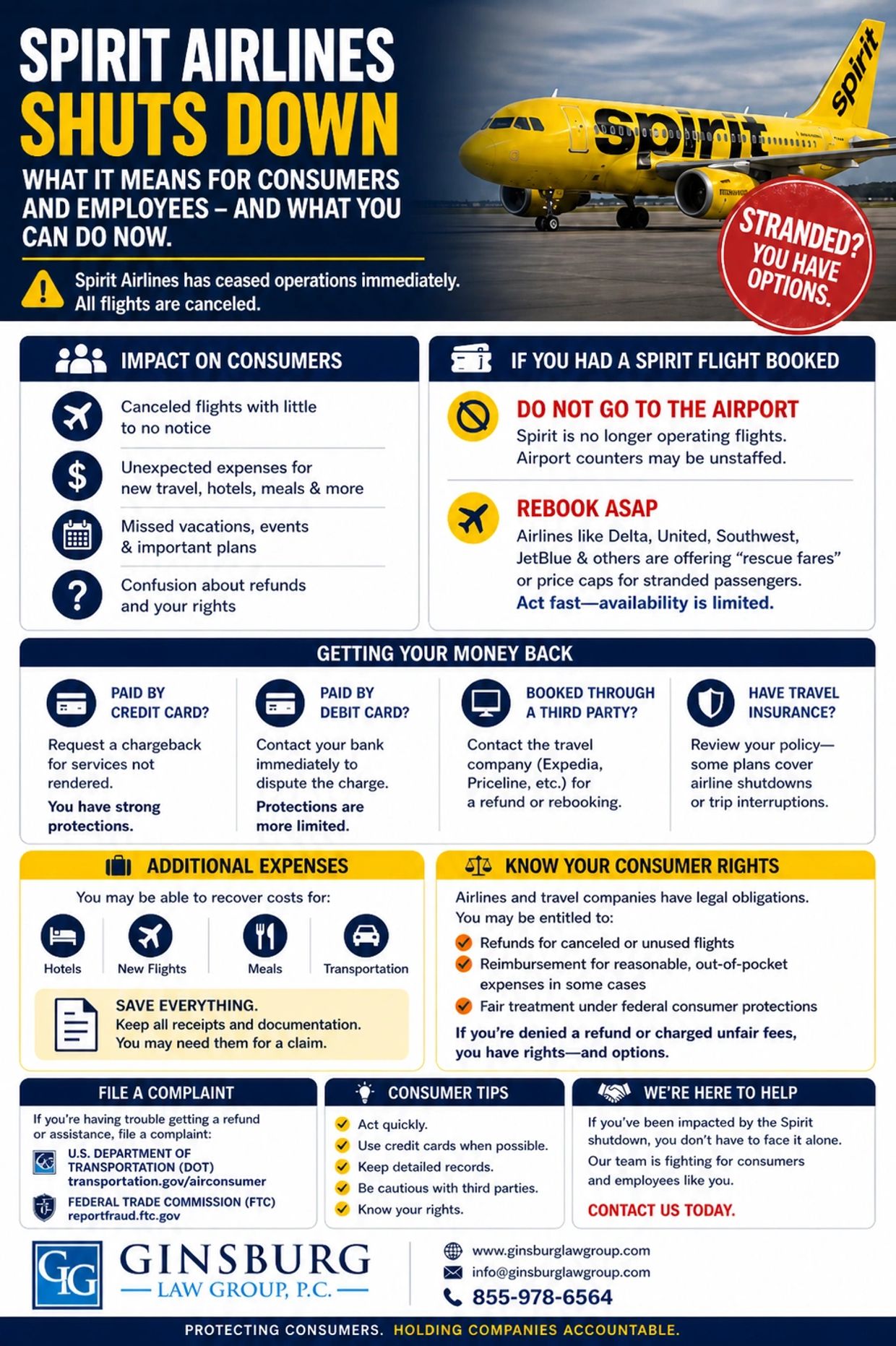
05/03/26- Were you impacted by Spirit Airlines canceling flights or ceasing operations? Ginsburg Law Group can help you understand your rights.
Spirit Airlines has reportedly begun winding down operations, leaving consumers with canceled flights, unexpected expenses, and confusion about refunds and rebooking options. Reports also indicate thousands of Spirit employees may be affected.
Spirit Airlines has reportedly begun winding down operations, leaving consumers with canceled flights, unexpected expenses, and confusion about refunds and rebooking options. Reports also indicate thousands of Spirit employees may be affected.
If your flight was canceled, you may be dealing with:
- Canceled travel plans
- Being stranded away from home
- Replacement flight costs
- Hotel, meal, and transportation expenses
- Delayed or denied refunds
- Trouble reaching Spirit or a third-party booking company

What Consumers Should Do Now
1. Do Not Wait to Rebook
If you are stranded or still need to travel, check other airlines immediately. Reports indicate several carriers may be offering assistance, reduced fares, or “rescue fares” for affected Spirit passengers.
Check directly with major airlines, including:
- American Airlines
- Delta Air Lines
- United Airlines
- Southwest Airlines
- JetBlue
- Frontier
- Allegiant
Availability may be limited, and options can change quickly.
2. Request a Refund
If Spirit canceled your flight, you should request a refund. If you paid by credit card, you may also be able to dispute the charge as a service not provided.
3. Save Everything
Keep copies of:
- Your Spirit confirmation
- Cancellation notices
- Receipts for new flights
- Hotel and meal receipts
- Transportation expenses
- Emails or chats with Spirit or booking websites
What Consumers Should Do Now
4. File a Complaint
If you cannot get help or your refund is delayed, you can file complaints here:
U.S. Department of Transportation Aviation Consumer Protection
https://www.transportation.gov/airconsumer
FTC Report Fraud
https://reportfraud.ftc.gov
💳 Refund & Financial Protection Resources
FTC Consumer Protection (Refund / Fraud Issues)
🔗 https://reportfraud.ftc.gov
Consumer Financial Protection Bureau (CFPB)
🔗 https://www.consumerfinance.gov/complaint/
- Useful if banks/credit cards deny disputes

Partner Airlines Offering Rescue Fares & Travel Assistance
Following Spirit Airlines’ sudden shutdown, several major airlines have stepped in to help stranded passengers reach their destinations. While Spirit did not have traditional “partner airlines” or interline agreements (meaning they cannot automatically rebook you), competing carriers are voluntarily offering discounted “rescue fares,” capped pricing, and additional flights to accommodate affected travelers.
Airlines Offering Relief Options
The following airlines have announced programs to assist Spirit passengers:
- American Airlines – Offering discounted “rescue fares” on overlapping routes and adding capacity where possible.
- Delta Air Lines – Providing reduced fares for a limited time on key domestic and international routes.
- United Airlines – Offering capped fares (often around $199–$299 one-way) for stranded travelers who provide proof of a Spirit booking.
- Southwest Airlines – Flat-rate fares based on distance (approximately $200–$400 one-way) available at airport ticket counters.
- JetBlue – Limited-time rescue fares (some as low as ~$99 one-way) for travelers with confirmed Spirit itineraries.
- Frontier Airlines – Offering discounted fares, in some cases up to 50% off base pricing.
- Allegiant, Avelo, and other low-cost carriers – Providing discounts, fare freezes, or promotional codes depending on routes.
Government officials have also confirmed that most major U.S. airlines are coordinating to prevent price gouging and expand availability for displaced passengers.
Important Conditions to Know
These rescue fares are helpful—but they are not automatic:
- You typically must show proof of a Spirit booking (confirmation number or receipt)
- Offers are often time-limited (sometimes 72 hours to two weeks)
- Availability is limited by route and seat capacity
- Some fares may be nonrefundable or restricted
Because Spirit does not have formal airline partnerships, you will still need to book a new ticket yourself—these programs simply reduce the cost.
🧳 Airline Travel Alerts / Help Pages
These are the best places for rescue fares, waivers, and rebooking flexibility (they update in real time):
- American Airlines Travel Alerts
https://www.aa.com/i18n/travel-info/travel-alerts.jsp - Delta Travel Updates
https://www.delta.com/us/en/advisories/current-advisories - United Travel Alerts
https://www.united.com/en/us/fly/travel/trip-planning/travel-alerts.html - Southwest Travel Advisories
https://www.southwest.com/travel-advisories/ - JetBlue Travel Alerts
https://www.jetblue.com/travel-alerts - Frontier Travel Alerts
https://www.flyfrontier.com/travel/travel-advisory/ - Allegiant Travel Alerts
https://www.allegiantair.com/travel-alerts
👉 These are the pages where “rescue fares” or fee waivers will typically be posted.

If You Booked Through Expedia, Priceline, Booking.com, or Another Site
Contact the third-party booking company directly. Ask for:
- A full refund
- Rebooking assistance
- Written confirmation of your request
- A case or reference number
If they refuse to help, document the denial and consider disputing the charge with your credit card company.

Additional Support for Employees
Many of these airlines are also assisting displaced Spirit employees by:
- Offering free or discounted travel to return home
- Hosting job fairs and recruiting events
- Providing priority hiring consideration
This coordinated response is designed to help both consumers and workers affected by the shutdown.
What About Travel Insurance?
Review your policy carefully. Some travel insurance policies may cover airline insolvency, trip interruption, or cancellation-related expenses. Others may exclude bankruptcy or airline shutdowns.
Before accepting any partial reimbursement, make sure you understand whether accepting payment affects other claims.
🌍 Travel Insurance & Assistance
U.S. State Department Travel Info
🔗 https://travel.state.gov
- Especially useful if travelers are stranded internationally
Travel Insurance Claim Help (NAIC)
🔗 https://content.naic.org/consumer.htm
- Helps consumers understand coverage and file complaints
Official Government & Consumer Help
U.S. Department of Transportation (DOT) – Airline Consumer Protection
🔗 https://www.transportation.gov/airconsumer
- File complaints
- Learn refund rights
- Track airline obligations
DOT Flight Disruptions Dashboard
🔗 https://www.transportation.gov/airconsumer/airline-customer-service-dashboard
- Shows what each airline offers for cancellations/delays
- Helpful when rebooking with another carrier
Key Takeaway
While Spirit Airlines is no longer operating, you are not without options. Multiple airlines have stepped in to provide discounted alternatives—but you must act quickly and proactively to take advantage of these offers.
What Do They Stand to Gain?

Why Robocallers Keep Calling (Even Though They Can Be Sued)
2/18/26- There’s a moment in The Office where Jim questions DeAnge/lo's fake juggling routine:
“What could he stand to gain from a fake juggling routine?”
Pam responds:
“What could he stand to gain from a real juggling routine?”
It’s a joke about motive. But it’s also the right question to ask when it comes to robocalls and spam texts.
Because if companies can get sued for illegal robocalls under the TCPA…
Why do they keep calling?
Why do they keep texting?
What is the purpose?
What do they stand to gain?
By the way... I'm a huge Office fan... but if you don't remember DeAngelo Vickers was Michael Scott's replacement when he moved to Colorado with Holly. :)

Yes — They Can Get Sued
Under the Telephone Consumer Protection Act (TCPA):
- $500 per illegal call or text
- Up to $1,500 per call if willful
That sounds serious.
So why would a company risk sending 10,000 texts?
Why risk 100,000 robocalls?
Why keep texting after someone replies STOP?
They can get sued.
So again: What do they stand to gain?
The Answer: Volume
Because only a fraction of people sue.
That’s the math.
Let’s be honest.
How many people reading this article are getting robocalls or spam texts right now… and doing nothing about it?
Actually — this author included. I get multiple per day.
We ignore them.
We block the number.
We delete the text.
We move on.
And they know that.
The Business Model
Robocall campaigns work on scale.
If a company sends:
- 100,000 texts
- 1% respond
- 0.1% convert
- A single converted customer generates $500–$2,000 in profit
That campaign may still be profitable — even if a few people sue.
They calculate that:
- Most people won’t know their rights.
- Most people won’t preserve evidence.
- Most people won’t contact a lawyer.
- Most people will just ignore it.
So what do they stand to gain? Revenue.
Why Do They Keep Texting After “STOP”?
This is where the motive question becomes even sharper.
If someone replies STOP and the messages continue, that’s riskier.
So why do it? Because:
- Opt-out systems fail.
- Vendors don’t sync databases.
- Marketing departments push volume.
- Compliance isn’t prioritized.
- They assume enforcement is rare.
And often, they’re right.
Only a small percentage of recipients ever assert their TCPA rights.
“They Know They Can Get Away With It”
That sounds cynical — but from a business risk perspective, it’s often true. If:
- 10,000 people receive a message,
- 50 complain,
- 5 hire attorneys,
- 1 files a lawsuit,
The campaign might still turn a profit.
That’s the calculation.
Not because it’s right.
But because it’s profitable.
Let's Look at the Numbers...
📞 How Many Robocalls Are Made Each Year? In the United States -
- ~50–55 billion robocalls per year in recent years
- That averages 4+ billion per month
- Roughly 150+ million robocalls per day
At peak periods, Americans receive over 4 billion robocalls per month. Let that sink in.
📱 Spam Text Messages - Spam texts are exploding -
- Americans receive tens of billions of spam texts per year
- In some estimates, over 20–30 billion spam texts annually
- SMS phishing (“smishing”) reports to the FTC have increased dramatically over the past few years
Consumers now report receiving more unwanted texts than calls in many cases.
But.... ⚖️ How Many TCPA Lawsuits Are Filed?
Despite tens of billions of calls and texts… Only a few thousand TCPA lawsuits are filed per year.
Typical annual filings:
- Roughly 1,500–3,000 federal TCPA cases per year
- Additional cases filed in state courts
Even if we assume 3,000 lawsuits in a year… Compared to 50+ billion robocalls.
That’s a microscopic enforcement rate.
📊 The Math... If:
- 50,000,000,000 robocalls are made
- 3,000 lawsuits are filed
That’s: 0.000006% enforcement
That’s why they keep calling.
They’re betting most people:
- Won’t know the law
- Won’t preserve evidence
- Won’t contact counsel
- Won’t sue
💰 FTC Complaint Data - Each year:
- The FTC receives millions of complaints about unwanted calls
- Robocalls consistently rank among the top consumer complaints nationwide
But complaints ≠ lawsuits.
That gap is where the business model survives.
Americans receive over 50 billion robocalls a year.
Only a few thousand TCPA lawsuits are filed annually.
That’s the math.
That’s what they stand to gain.
If even 1% of recipients enforced their rights, the robocall industry would collapse overnight.
That’s not hyperbole. It’s economics.
(Sources: YouMail Robocall Index, FCC tracking data)
Why the TCPA Still Matters
The TCPA exists precisely because volume marketing creates incentives to overreach.
The law shifts the equation.
$500 per call or text.
$1,500 if willful.
Suddenly, scale becomes dangerous.
One person with 20 unlawful texts could mean:
- $10,000 minimum
- Up to $30,000 if willful
And when companies realize consumers enforce their rights, the math changes.

The Real Question
So when your phone lights up again…
Ask the same question:
What do they stand to gain?
And then ask:
What do you stand to gain by doing nothing?
Most people delete the message.
Most people block the number.
Most people never assert their rights.
That’s the gap the business model relies on.

The Bottom Line
Robocalls and spam texts continue not because they’re legal — but because they’re profitable. They stand to gain:
- Volume conversions
- Easy revenue
- Minimal enforcement
But when consumers understand their rights under the TCPA, that equation changes. And that’s why the question matters. What do they stand to gain?
And more importantly —
What are you going to do about it?
The Disappearing Spare Tire

What Every Car Buyer Needs to Know
2/10/26 - For decades, a spare tire was considered a basic safety feature. If you got a flat, you pulled over, changed the tire, and continued on your way. Today, many consumers are learning — often at the worst possible moment — that their new vehicle doesn’t have a spare tire at all.
Instead, automakers are increasingly selling vehicles with nothing more than a small air compressor, a bottle of sealant, or in some cases, no backup equipment whatsoever. This quiet shift has left many drivers stranded, frustrated, and facing unexpected towing and repair costs.
Why New Cars Often Don’t Include a Spare Tire
Automakers have been steadily removing spare tires in an effort to reduce vehicle weight and improve fuel economy. Lighter vehicles help manufacturers meet efficiency standards and reduce production costs. But while this change benefits manufacturers, it often creates real-world problems for consumers.
According to Consumer Reports, vehicles sold since 2020 break down roughly as follows:
- Only 9% include a full-size spare tire
- 46% include a temporary “donut” spare
- 34% come with only a compressor and tire sealant kit
- Approximately 4% include no flat-tire solution at all
For many drivers, this means a single pothole or piece of road debris can leave them completely dependent on roadside assistance or a tow truck.
Why “Fix-a-Flat” Kits Are Not a Real Substitute
Tire sealant kits are often marketed as a modern replacement for spare tires. In reality, they only work in very limited situations.
Sealant kits typically do not work if:
- The damage is in the sidewall
- The tire has suffered a blowout
- The puncture is too large
- The tire pressure dropped too low before the driver noticed
These scenarios are common — especially with potholes, highway debris, and curb damage — which means many drivers discover too late that their emergency kit is useless.
What Consumers Should Check Immediately
If you own or are shopping for a vehicle, it’s important not to assume anything about what is included.
Check your vehicle now:
- Look under the trunk floor or cargo mat
- Check beneath the rear of the vehicle for an externally mounted spar
- Identify whether you have a spare tire, a donut, or only a sealant kit
If you see molded foam, a small compressor, or a bottle of sealant, you likely do not have a spare tire.
Confirm your exact trim level. Two vehicles that look identical can have very different equipment depending on trim level and options. Review the window sticker, owner’s manual, or VIN-specific equipment list. If you’re buying a used vehicle, do not rely on online listings. Many sellers incorrectly assume a spare tire is included.
What to Ask Before Buying a Car
If you’re purchasing a new or used vehicle, don’t ask whether it has a spare tire. Ask the dealer to physically open the trunk and show you what is included.
If the vehicle does not have a spare:
- Ask whether one can be added
- Negotiate to have a spare included in the deal
- Ask whether the vehicle is designed to safely store on
- Confirm whether adding a spare affects cargo space or vehicle performance
These are reasonable questions — and asking them before signing paperwork can save significant expense later.
Should You Buy a Spare Tire Separately?
For many consumers, purchasing a spare tire after the fact is worth considering. While spare tires are not inexpensive, towing and emergency roadside services can be far more costly — especially at night, during bad weather, or in remote areas. Before purchasing a spare, make sure to confirm:
- Correct wheel size and bolt pattern
- Brake clearance (particularly important for hybrids and electric vehicles)
- Whether your vehicle includes a jack and lug wrench (many do not)
- Safe storage options
In many cases, the cost of a spare tire is less than the cost of a single tow.
The Consumer Takeaway
The elimination of spare tires is a significant change that many buyers do not discover until after the sale — and sometimes not until they are stranded.
Consumers should be informed about what safety equipment is included in their vehicles and should not assume that long-standing features are still standard.
If you believe important safety information was not clearly disclosed during your vehicle purchase, or if you were misled about what was included, you may have legal rights under state and federal consumer protection laws.
Being informed before a breakdown happens can make all the difference.
